Precision Agriculture with Veleres - FCOVER Index
A short guide to FCOVER in precision agriculture: how it differs from NDVI, and how combining both indices helps identify field issues earlier in the season.
FCOVER: Not Just How Green the Plant Is, But How Much of the Ground It Actually Covers
Estimated reading time: 2 minutes
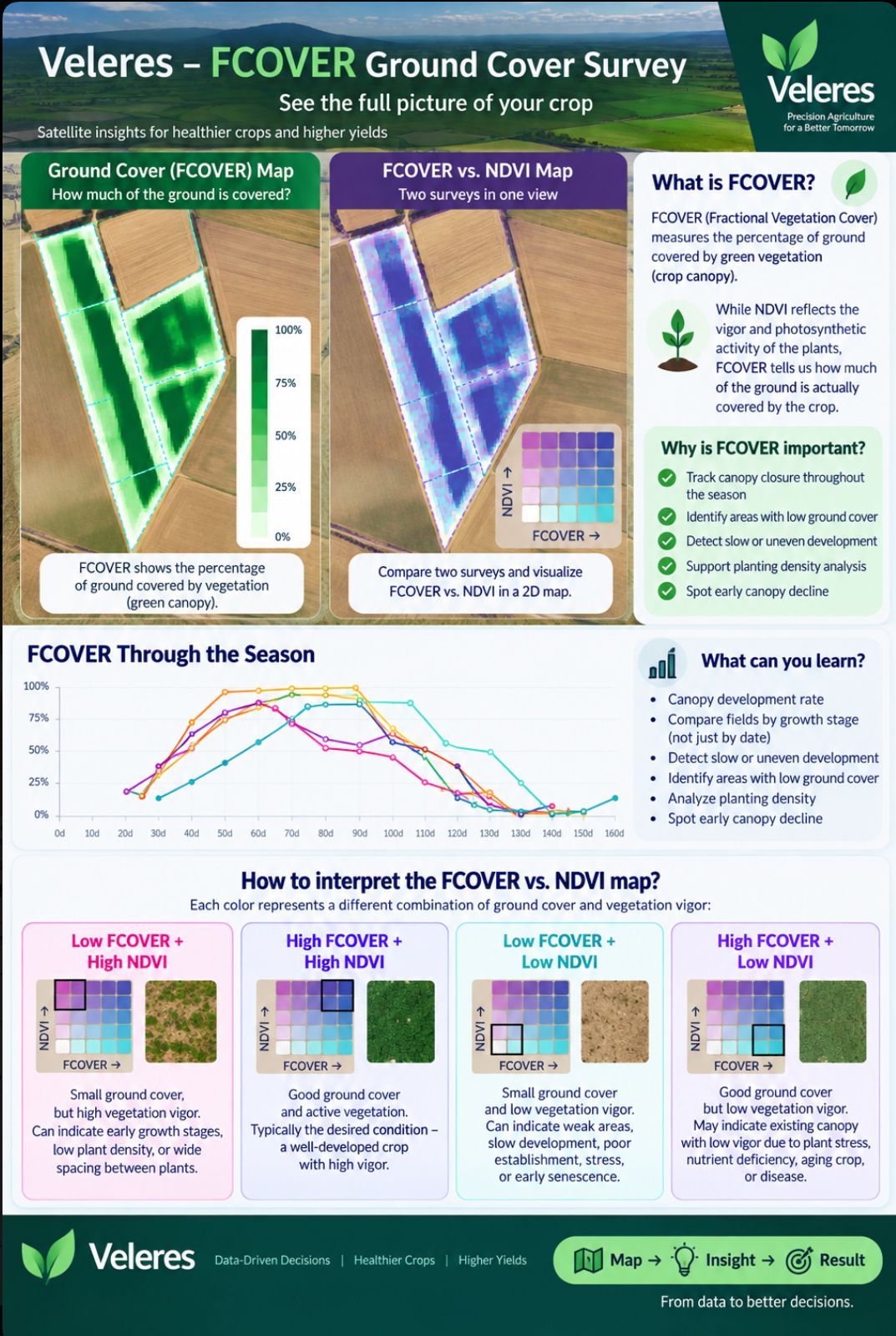
FCOVER, or Fractional Vegetation Cover, is an index that describes the percentage of the area covered by green vegetation. Unlike NDVI, which mainly represents the intensity of vegetation activity and vigour, FCOVER helps us understand how much of the ground is actually covered by the crop.
That's why combining both indices gives a more complete picture: NDVI tells us how active the vegetation is, while FCOVER tells us how much of the area it covers.
Why Does FCOVER Matter?
Throughout the season, FCOVER makes it possible to track the rate of canopy closure and identify differences between areas and plots. It can help identify:
- Slow or uneven crop development
- Areas with insufficient cover
- Differences in plant density
- Early decline in cover toward the end of the season
A FCOVER graph over the course of the season also allows plots to be compared by crop age rather than only by imaging date, showing which plots reach full cover faster and which start losing cover earlier.
What Can We Learn From Comparing FCOVER and NDVI?
In Veleres, you can select two surveys and display FCOVER against NDVI on a two-dimensional map. Each colour represents a different combination of cover level and vegetation vigour.
High FCOVER + High NDVI: Good cover and active vegetation. This is generally the desired state - a closed canopy with high plant activity.
Low FCOVER + Low NDVI: Little cover and low vigour. This combination may indicate a weak area, slow development, plant gaps, stress, or early drying.
High FCOVER + Low NDVI: The area is well covered, but vigour is relatively low. This situation may indicate existing vegetation that is weak, ageing, or under stress. In other words, high cover alone does not necessarily indicate a good condition.
Low FCOVER + High NDVI: Relatively little of the area is covered, but the existing vegetation is highly vigorous. This can fit early growth stages, low density, or large gaps between plants.
The Advantage of Combining the Indices
When looking only at NDVI, two very different areas can receive a similar value. Combining it with FCOVER makes it possible to separate the amount of vegetation from its condition, giving a better understanding of what lies behind the variability seen in the field.
This allows moving from a map that only shows where a difference exists, to a map that helps understand what kind of difference it is, where it's worth checking in the field, and where corrective action is needed - as early as possible during the season.